
The success of lands located in the arid areas of Pakistan (namely Thar, Cholistan, and Thal) depends on one very simple concept: they are not equal; the various species of desert trees all have their own unique abilities to perform “work” in the environment where they exist.
The Desert Champions – Head-to-Head Comparison
| Feature | Jand (Kandi) | Ber (Jharberi) | Rohida | Frash (Ghaz) |
| Growth Speed | Slow establishment, long lifespan | Fast establishment | Moderate, steady | Very fast colonizer |
| Drought Survival | Extreme (deep taproot system) | High (adapts quickly) | Very high | Extremely high |
| Soil Contribution | Strong nitrogen fixation | Improves organic matter | Stabilizes soil structure | Prevents erosion only |
| Economic Cycle | Long-term ecological value | Short-term + recurring fruit income | High-value delayed return | Indirect value (protection) |
| Maintenance Need | Very low | Medium (pruning/harvest) | Very low | Very low |
| Ecosystem Role | Soil builder | Income + food security | Luxury asset tree | Wind barrier system |
The Core Players – Deep Performance Profiles
The Ecosystem Engineer – Jand (Prosopis cineraria)
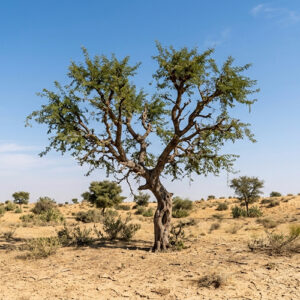
Jand is more than just a tree; it is a complete system for rehabilitating the earth’s soils and one of the most valuable desert trees for restoring arid ecosystems.
Expanded Advantages
- The root system reaches into deeper layers of moisture that cannot be reached by surface rain, which allows the plant to survive without relying on surface water sources.
- Jand enhances the number of micro-organisms in the soil, which improves the health of crops around it.
- Jand produces shade to cool crops; however, it does not block out sufficient light to prevent mixed cropping, thus allowing for mixed cropping systems.
- Jand’s leaves are an important source of high-quality forage for animals during drought periods.
Hidden value
It also contributes indirectly to food security systems in the rural desert area by stabilising soil quality and providing a steady supply of forage.
Strategic warning
In the early years, Jand grows very slowly, resulting in many people abandoning their plantations due to unrealistic growth expectations before making a commitment. The Jand tree rewards those who continue to stay patient and not strain their resources in order to force the tree to grow.
The Income Generator – Ber (Ziziphus Mauritiana)
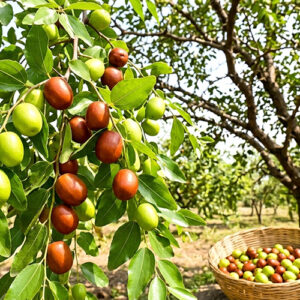
The Ber is one of the most valuable fruit trees and the mainstay of most desert agri-enterprises/agriculture, and among the most commercially successful desert trees in Pakistan’s dry regions.
Expanded Advantage
- Produces fruit when water-stressed or dry.
- Attracts birds and provides pollination, which increases biodiversity.
- Can be interplanted with legumes in the early stages of its life.
- It can be used as an alternative to fencing by being planted with thorns on fence lines (living fence).
Market insight
- Local fresh fruit markets have a high demand for the fruit.
- Value-added products increase profitability (dried ber, jams, herbal uses).
- Rural trade is well established in desert areas.
Strategic advantage
Ber trees have a low risk factor for an agricultural investment, and they provide quick returns with low maintenance and care.
The Long-Term Asset – Rohida (Tecomella undulata)
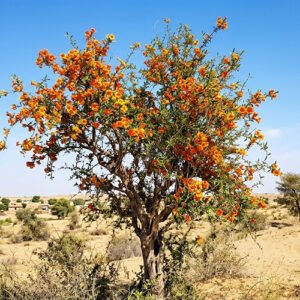
An Indian heritage wood investment in the desert ecology.
Expanded advantages
- Extremely durable hardwood for luxury furniture/carpentry, etc
- Acclimation with the desert habitat – deep ecology
- Seasonal flowering supports pollinators in resource-deficient locations.
- Resilient to extreme heat and prolonged droughts
Long-term value
- Gain value over time spans of decades, not years
- Can become an heirloom for future generations within land ownership
- Increasingly rare due to unsustainable harvesting of natural/untouched ecosystems.
Strategic warning
Strategically, Rohida is not to be used for return on capital in the short-term, but rather the land owner will be creating long-term portfolios of generational wealth.
The Shield Builder – Frash (Tamarix aphylla)
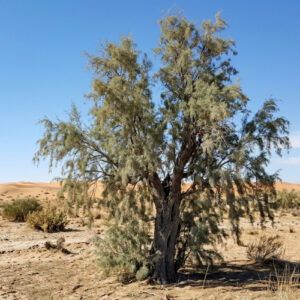
Frash functions as the infrastructure base of the desert farming systems.
Expanded advantages
- Greatly reduces wind velocity to provide protection for young, vulnerable saplings.
- It can grow successfully in highly saline or alkaline soils where other trees will not grow.
- Grows quickly to develop a dense protective wall.
- Provides stability to the shifting dunes found in desert regions.
Functional importance
Without Frash support, even Jand and Ber trees suffer from:
- Wind damage
- Soil desiccation
- Storm-related mechanical damage
Strategic role
Frash can be considered “insurance” for your plantation system.
The Winning Strategy – How Smart Plantations Work
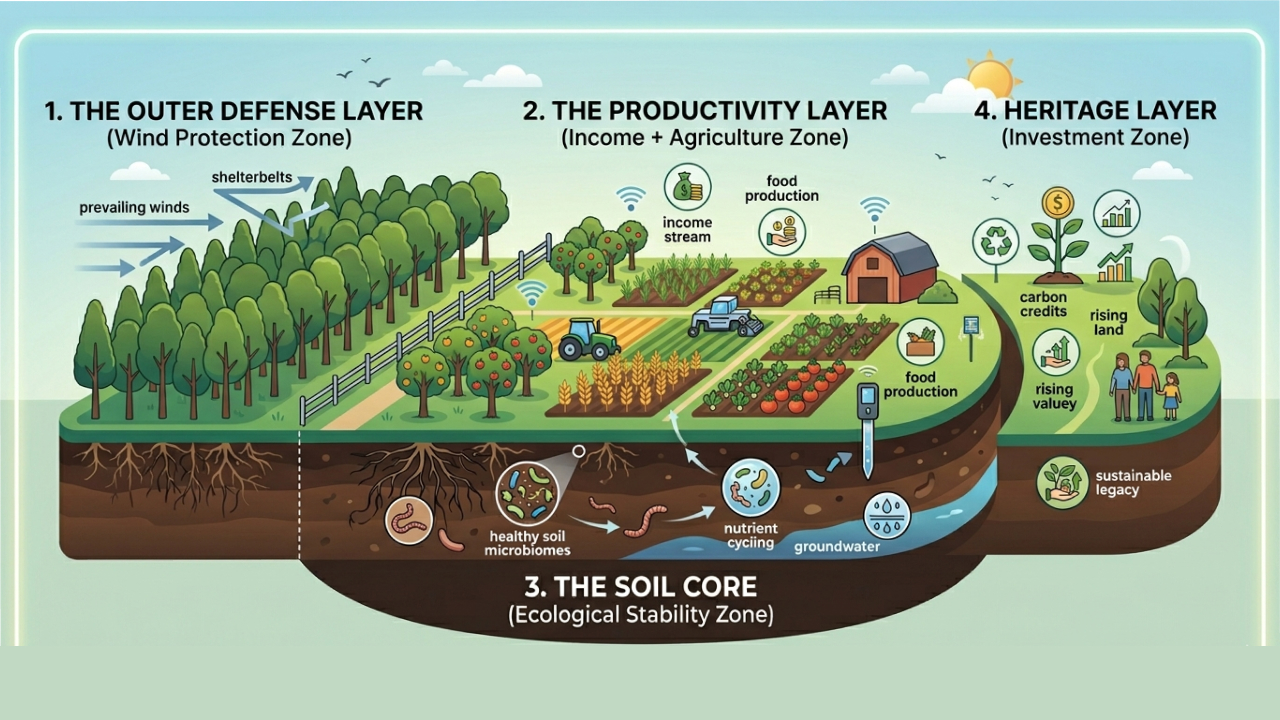
Desert farming is not simply random planting. It is a structured ecological engineering project for survival in the desert, where every effort to plant a tree supports sustainability.
The Outer Defense Layer (Wind Protection Zone)
It is also the first line of survival.
Expanded design
- Plant staggered rows of Frash tree, instead of one main row.
- Have Kikar trees planted interspersed with the Frash trees for better wind protection.
- Have a higher density of Frash trees on the west side of farmlands (the direction that most hot winds come from).
Function
- To reduce moisture loss through evaporation and transpiration.
- To protect young saplings from drying out.
- To create a microclimate near the ground inside the farm
The Productivity Layer (Income + Agriculture Zone)
A multiple-use area where economic activity takes place.
Expanded design
- Plant Ber along the edges of fields and on pathways.
- Intentionally spaced for limb light.
- Combine fruit-bearing species with fast-growing trees in Pakistan to diversify farm production.
Function
- Provides opportunities for continuous income cycles.
- Supports livestock feeding systems.
- Provides a buffer from the financial loss of crop failure.
The Soil Core (Ecological Stability Zone)
The soil core is where land restoration occurs.
Expanded design
- Spread Jand throughout your entire property rather than grouping them together
- Avoid overcrowding in order to minimize competition
- Let the areas protected get naturally regenerated
Function
- Improve soil fertility for the long term
- Decrease dependence upon fertiliser
- Recover degraded land over time
Heritage Layer (Investment Zone)
This is how you will accumulate wealth in the future.
Expanded design
- Plant Rohida trees in a selective manner rather than densely
- Protect from grazing in the first years
- Allow for full maturity cycles without disturbance
Function
- Build timber capital for the long term
- Increase land value over a time period measured in decades
- Preserve ecological heritage
Survival Upgrade – Water Strategy
No water plan means even the best trees won’t survive in a desert.
Contour Bunding (Rain Capture System)
- Helps slow down how fast rain runs off down the hill.
- Takes the water and puts it right into the root zone.
- Prevents erosion of the soil on the hillside.
Micro Catchments
- Helps to funnel the water directly to the saplings.
- It’s critical that they have this in the first 2-3 years.
- Significantly improves the sapling survival rate.
Farm Ponds
- Provides an emergency reserve for the irrigation plant during drought.
- Can be integrated with livestock systems.
Mulching System
- Lowers soil temp.
- Reduces evaporation loss of moisture.
- Improves the amount of organic matter as time goes on.
Final Verdict – Who Wins the Desert?
To win in the desert environment requires a series of integrations between desert trees and other natural systems to work together and create an ecosystem.
- Jand: A long-term intelligent system in the ground.
- Ber: A fast return from economic engines on the ground.
- Rohida: An asset of generational wealth in the ground.
- Frash: The infrastructure that protects survival.
You Might Like to Read: